
Hand D belongs to one of six different authors who contributed to the manuscript of Sir Thomas More now in the British Museum. Outside anti-Stratfordian argument, there are few scholars who do not accept Hand D as Shakespeare's. Here we review the reasons why the doubts have evaporated and why the argument that we have nothing in Will's hand is dead.

The new paradigm—collaborative authorship
Oxfordians have been pushing for the adaptation of a new paradigm for Shakespeare Studies for years. They have a clear vision of it. In the Oxfordian New Paradigm, Authorship Studies assume pre-eminence in the modern Shakespearean English Faculty. Orthodox scholars are deposed and the newly enlightened Faculties are taken over by heroes of the resistance movement, leading students to a new dawn of truth and enlightenment with the Earl of Oxford finally and rightfully on his Olympian throne
There is a new paradigm. It does indeed bring authorship studies closer to the forefront of scholarship activity. But the Gods of Olympus, especially The Muses, are inexorable and merciless. In the new paradigm of Authorship Studies, computer-assisted scrutiny, multiple authorship, collaborative production and detailed attribution of fragmentary contribution have caused The Earl of Oxford to completely disappear from view.
Will and Sir Thomas More
Highly political, much too topical for Elizabethans and therefore never performed, the play Sir Thomas More survives in manuscript in The British Museum. The manuscript is more than just an unperformed play. It is written in six different hands with deletions and emendations by all six writers which illustrate how plays were worked and reworked for the stage. It paints a picture of the creative process which is much closer to the modern process of TV or movie scriptwriting with groups of writers improving and altering a script. Then the original author reappears, recovering and repairing what he can.
After a long time on the shelf, the doctored remains are given to a master playwright who adds a few pages which suggest a new direction. Maybe. Who knows? It should be obvious is that content creation for the professional in the 1590's has more in common with playwrighting today than it does with playwriting in the 1570's, just 20 years earlier. It is a process that involves presence in a theatre. Work with actors and stage managers. And other writers.
The handwriting evidence
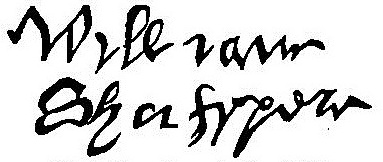
Six signatures are all that remain and Oxfordians like to discount all of them. What can we really tell from the signatures Will left behind and since they are from the same hand, can they be tied to Hand D?
The stylometric evidence

Elliot and Valenza's Shakespeare Clinic fell short of attributing Hand D to Will. 'If it's Will,' they conclude, 'he didn't write it in 1593'. Does this rule Hand D out or could the chronology accommodate E&V's comments?
The internal evidence

Will's style features a poetic verbal dexterity that is unequalled amongst his playwright peers. Are there any signs of it in the text of Hand D?
The Academic Analysis
Hand D wasn't accepted straight away by the academic community. Why has it now become so widely accepted?
External Links
Links to external sites referencing Shakespeare's handwriting and Hand D.